“It was the best of times, it was the worst of times.” — Charles Dickens
In infrastructure, that line has never been more true.
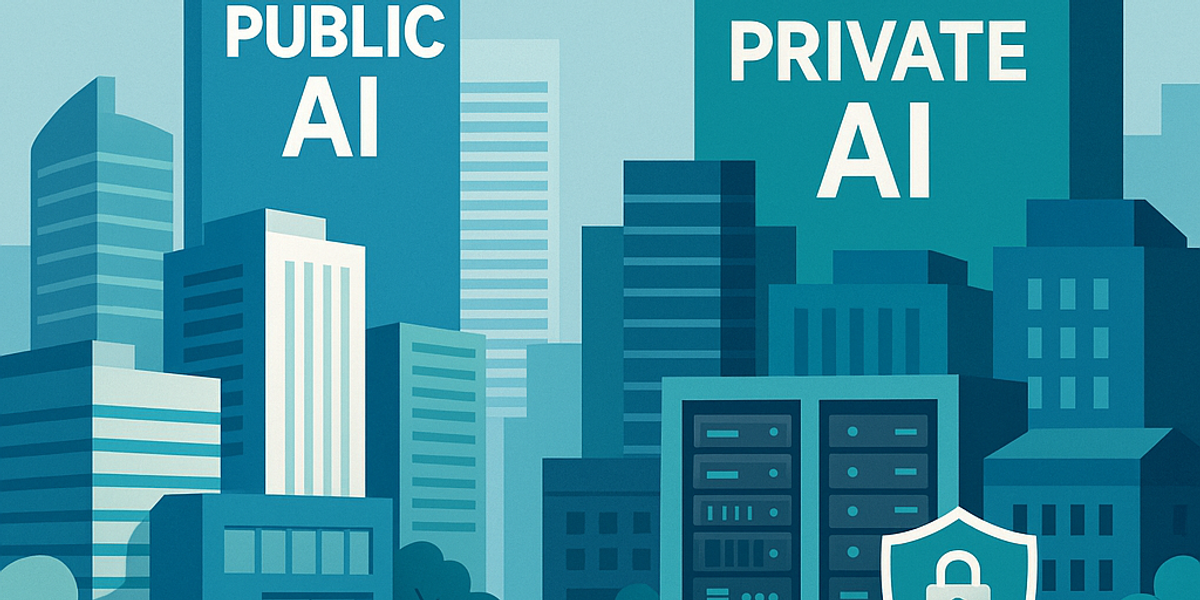
The world is racing into an AI-powered future. And while public AI is grabbing the headlines, private AI is quietly becoming the real story — for enterprises that care about control, security, performance, and sovereignty.
2025- a wave of signals from earnings calls, customer meetings, and analyst reports all point to one thing:
🔒 Private AI got real.
TL;DR
✅ NVIDIA hit $39B in datacenter revenue (up 171% YoY), citing strong demand from enterprise and hosted infrastructure partners.
✅ Broadcom’s VCF 9 strategy is now central to its hybrid cloud play, with VMware Explore announcements doubling down on enterprise private cloud.
✅ Nutanix is growing customer count fast, leaning into the churn and uncertainty post-VMware acquisition.
✅ Equinix and Digital Realty report strong enterprise demand for colocation, with AI-specific infrastructure and power availability as primary drivers.
✅ And OpSky is joining the conversation, delivering a platform purpose-built for the operators, engineers, and admins who are building the next wave of infrastructure.
The Tale of Two Applications
A rift is opening between two application worlds:
- Public AI apps — Chatbots, copilots, public web queries, generic GenAI content.
- Private AI workloads — Sensitive data, regulatory boundaries, business-specific models and fine-tuning.
One thrives in hyperscale clouds. The other demands trust, control, and data gravity.
And that second category? It’s growing — fast. At a recent customer roundtable, a major financial services firm described how they’ve moved all internal LLM workloads onto private infrastructure due to latency, compliance, and tuning requirements. In retail, Walmart is investing heavily in private cloud modernization using VCF 9. In telecom, Deutsche Telekom has cited edge and private AI initiatives for latency-sensitive use cases. And across banking, healthcare, and government, CIOs are rethinking their AI deployments to prioritize proximity to data, security, and control.
While self-serving as a VMware owner, the Broadcom study still offers a directionally useful glimpse into enterprise behavior.
- 55% of enterprises are already running GenAI workloads like inference or fine-tuning on private infrastructure.
- 69% are considering repatriating public cloud workloads to private cloud; 33% already have.
- And 84% are building cloud-native apps privately — because the old boundaries between “legacy” and “modern” are breaking down.
NVIDIA Leads, Everyone Follows
NVIDIA’s Q2 earnings call showed what momentum looks like:
"Demand for NVIDIA AI infrastructure is surging — not just from hyperscalers, but also from enterprise customers, software vendors, and colocation providers.”
— Jensen Huang, CEO, NVIDIA
Their $39B in datacenter revenue (up 171% YoY) wasn’t just driven by cloud providers. It came from a growing wave of private AI deployments — powering everything from internal copilots to real-time fraud detection.
And who’s standing up that infrastructure?
Admins. Engineers. Operators.
Datacenters Are Building Again
The rise of private AI is fueling real physical infrastructure growth:
- Equinix saw AI colocation demand across BFSI, healthcare, and telecom sectors, citing high-density rack usage as a trend.
- Digital Realty is expanding AI-ready data halls and reported continued momentum from enterprise buyers.
- HPE and Dell emphasized AI-optimized server revenue and private cloud wins in their recent calls.
- NetApp is increasingly leaning into hybrid AI architectures and storage pipelines for GPU environments.
And Broadcom’s VMware is betting the house on VCF 9 — refocusing on private cloud, with the Walmart deal as a marquee proof point (CIODive).
Admins Are the Linchpin
Enterprise conversations at #VMwareExplore all echoed a common refrain:
🛠️ "We want power tools — a control plane, not a toy."
🔐 "We can’t send data to OpenAI or the public cloud."
👥 "Our partners are advising us: either modernize to VCF 9 or migrate out."
The stakes are high. Complexity is rising. And admins are back in the spotlight — asked to re-architect critical workloads, balance GPU clusters, enforce zero-trust, and do it all with fewer tools and tighter compliance.
OpSky Joins the Conversation
Two weeks ago at VMware Explore, we met over 100+ customers, admins, and partners — from government to fintech, pharma to energy.
And we heard the same thing, over and over:
“We need one interface. One trusted system. One place to get our job done.”
OpSky is answering that call.
Our platform gives admins a secure, private environment to automate patching, troubleshoot across vendors, and manage AI infrastructure at scale.
No cloud dependencies. No duct-taped scripts. Just intent → action.
One Last Thing: Startups Start Small
OpSky didn’t bring a booth or banners — just a stack of business cards and open honest dialogue. We showed up with curiosity, commitment, and a desire to listen. It was energizing to engage with so many in the VMware community — friends, ex-colleagues, partners, and customers — all deeply invested in shaping what comes next for infrastructure.
That’s all it takes to start a movement. We’re grateful for the incredible response — and for all the support from the VMware community.
Join us:
👉 opsky.ai/lighthouse — early access & feedback
👉 opsky.ai/interest-list — stay in the loop
And check out our previous blogs for more context:
The private AI era is here.
Let’s build what comes next.