How enterprise IT leaders can move beyond lift-and-shift to build a disciplined, value-driven cloud estate.
A decade ago, many companies moved their workloads to the cloud to capture elastic scale and cut costs. This strategy—moving on-premises applications to the cloud with minimal modification (“lift and shift”)—turned out to generate more technical debt and a significant “double bubble” as migration costs and efforts were significantly underestimated. As a result, public cloud costs skyrocketed while applications architected for data centers ran inefficiently in cloud environments.
Roughly one in three cloud migrations fail, and about 85 percent of cloud programs fall short of their business goals.
Today, most enterprises operate in hybrid environments by accident rather than by design. The pressing issue that technology executives now face is how to get a handle on their hybrid environments, where complexity and costs have spiraled well beyond initially intended, so they can capitalize on the compute required for the world of AI.
This demands a new playbook: one built not for speed, but for sustained optimization. We call it Cloud 2.0. In this article, we share an overview and examples of our Cloud 2.0 playbook, jointly developed by Kearney and ModernZ (pronounced “Modernize”).
The Cloud 2.0 optimization playbook
Cloud 2.0 represents a shift in how enterprises think about their hybrid environments. While Cloud 1.0 was about migration velocity—getting workloads off premises as fast as possible, Cloud 2.0 is about placement precision. It recognizes three realities: cloud adoption is continuous, not a one-time event; hybrid cloud is a steady state, not a transition; and business value comes from workload placement decisions, not from platform selection alone.
The central question in Cloud 2.0 is simple: where should each workload run to maximize business value today and over time?
To effectively move to Cloud 2.0 (optimization), companies will need to make cloud decisions based on workload realities rather than vendor narratives. Our playbook is a repeatable, analytical capability that combines Kearney’s decision framework with a bottom-up workload intelligence supported by ModernZ’s AI-driven engine. This playbook is cloud service provider (CSP) agnostic and more comprehensive than legacy cloud assessment and FinOps tools, evaluating placement across cloud native, cloud hosted, and modern on-premise alternatives with consistent total cost of ownership (TCO) scoring.
Our playbook is organized around three reinforcing clusters.
Cluster 1: workload intelligence and placement design
Optimization starts with having intelligence about your complete technical ecosystem. Leading companies have an effective top-down landscape and life-cycle management capabilities to know what they have, where it’s running, how “healthy” it is, and its dependencies to other assets in the environment.
This cluster builds the foundation: a clear picture of every workload across on-premises, private cloud, and public cloud environments. ModernZ pulls data from across the entire hybrid environment to build a unified view that helps teams optimize both sources and targets. It leverages RVTools output, configuration management database (CMDB) data, database and application information, licensing data, and monitoring data to construct a dynamic view of the existing estate with insights.(1) This estate can be further optimized with best practices for smart- sizing virtual CPU (vCPU), RAM, disk, zombie virtual machine (VM) detection, x86/ARM architecture selection, and licensing compliance.(2)
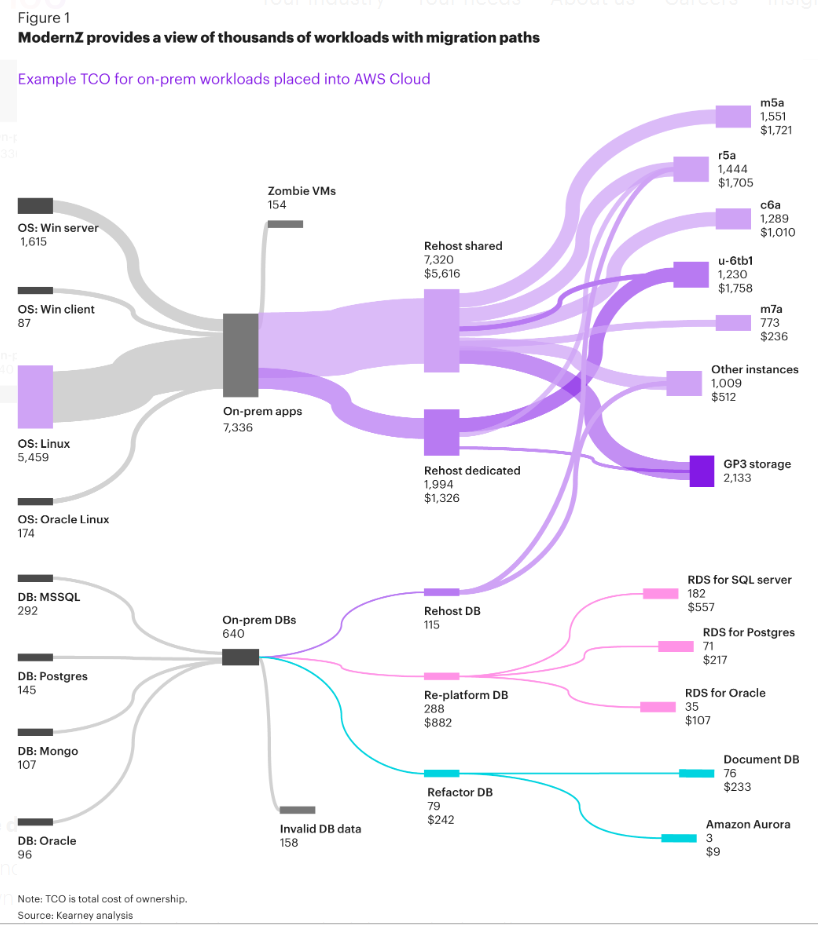
The next piece is a workload-first placement matrix that uses workload economics, technical requirements, security constraints, and risk profile to identify where each application belongs. With its understanding of well-architected frameworks for cloud providers and modern on-premises, ModernZ enables intelligent workload decisions such as whether an SQL server instance should be rehosted, re-platformed, or refactored, which provides a view of several thousand workloads in Amazon Web Services (AWS) with automatically computed migration paths (see figure 1). In the process, it flags ARM-based architecture opportunities that can cut compute costs by 25 percent or more without requiring code changes.
Cluster 2: landing zone determination
Defining a future-state landscape is often the easy part. More importantly, companies require rigorous top-down planning and a strong enterprise architecture discipline to ensure it’s the right future state. This is about replacing accidental complexity with intentional architecture. This means stepping back from one-off sourcing decisions and treating CSP relationships as a portfolio. It means building landing zones where security, identity, network standards, and cost tagging are embedded by design (not bolted on after the fact). And it means clarifying ownership and roles across various teams and functions to eliminate confusion that can be a significant and persistent source of waste.
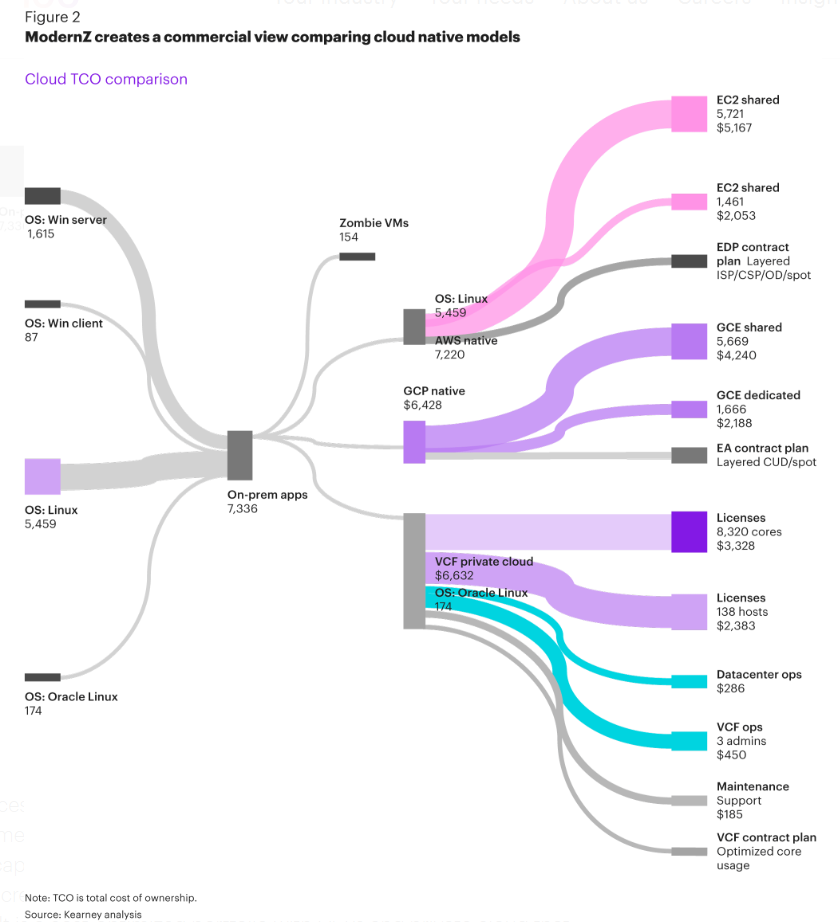
ModernZ’s catalog of blueprints enables this top-down governance across multiple provider targets. ModernZ enables teams to quickly compare workload placement across cloud native, cloud hosted, and modern on-premise targets based on architecture, cost, usage patterns, high availability, and reliability and automatically targets workloads to shared or dedicated infrastructure based on performance, licensing, and sovereignty requirements. Figure 2 provides a commercial view comparing cloud native (AWS and Google Cloud Platform) with private cloud (VMware Cloud Foundation) models.(3)
The platform also replaces the single-layer TCO model with a four-layer spending structure that segments commitments across reserved, on-demand, burstable, and spot capacity. This enables teams to capture practical commits with enterprise discount programs and offset with hyperscaler credits while modeling the true “steady state” costs of support and migration. The net result is a cost-optimized portfolio with CSPs and private cloud that puts the chief information officer in the driver’s seat.
Cluster 3: Migration and continuous optimization
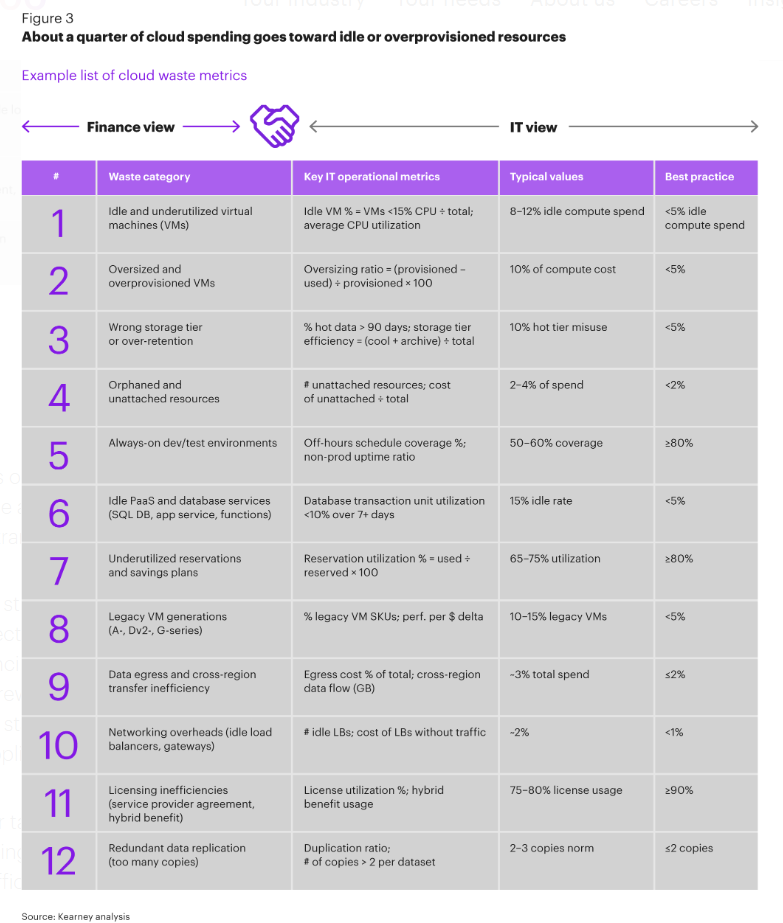
The third cluster builds the operating muscle to enable this discipline. According to industry surveys, 20 to 30 percent of total cloud spend is “waste,” meaning idle or overprovisioned resources (see figure 3). Companies need top-down financial and IT operational capabilities (FinOps) to not only plan the timing and effort it may take to migrate workloads to the cloud, but more importantly, monitor and manage them once they’re there.
One of the primary reasons one in three cloud migrations fail is that most companies don’t adequately plan for the time and effort needed to design and structure migration waves in a way that optimizes both transition and ongoing costs.
Migration waves should be structured around the 6R framework (retire, retain, rehost, re-platform, refactor, rearchitect) and combined with predictive risk scoring and dependency-aware sequencing to identify what shouldn’t move—yet or ever. This reduces the need for reversals and rework. ModernZ creates a migration wave plan based on risk profile for applications and stakeholders while preserving application dependencies between databases and application tiers.
Once workloads are in their target environments, continuous life-cycle management takes over, with AI-driven rightsizing, anomaly detection, proactive remediation, and feedback loops keeping the estate efficient as needs evolve.
Additionally, autonomous rightsizing identifies and remediates zombie VMs and idle resources in real time. Further rightsizing VMs based on usage patterns (enabling elastic autoscaling policies) and leveraging burstable instances together reduce sustained cloud spend by up to 30 percent.
Post-migration, Kearney’s FinOps best practices provide ongoing governance: establishing cost-allocation frameworks, defining optimization targets by workload tier, and creating accountability mechanisms to sustain savings over time. ModernZ is developing automated monitoring and remediation capabilities to operationalize these frameworks at scale, ensuring continuous alignment to cloud provider best practices and preventing cost drift.
An automotive company used a Cloud 2.0 approach to unlock $1.5 million in annual infrastructure savings compared with the standard AWS assessment baseline.
Cloud 2.0 in practice: an automotive services company
The significant value that the Cloud 2.0 playbook can generate is evident in the experience of a major automotive services company with thousands of VMs across a hybrid environment. The approach helped the company optimize its AWS migration strategy by uncovering four blind spots that legacy cloud assessment tools had missed, each with significant financial consequence:
Ghost peak detection and performance sizing. Standard tooling flagged only 10 percent of VMs for upsizing. The Cloud 2.0 assessment identified 95 percent as needing additional capacity, avoiding an estimated $850,000 annually in emergency remediation costs.
Licensing compliance and bring your own license (BYOL) optimization. Assuming shared tenancy would have triggered $3 million in duplicate licensing fees. Correct placement of Windows server and Oracle workloads on dedicated hosts eliminated that liability and reduced the annual run rate by 17.5 percent.
Multi-target placement intelligence. Unlike single-target vendor legacy tools, the assessment evaluated cloud native, cloud hosted, and modern on-prem alternatives side by side using consistent TCO scoring to determine the right architecture for each workload category.
Commercial architecture and migration assistance program (MAP) leverage. A four-layer spend model structured the $13.5 million commitment to match migration velocity and avoid Year 1 over-commitment while qualifying the company for $1.2 million in AWS MAP credits that offset 80 percent of parallel-run migration costs.
In aggregate, the Cloud 2.0 approach delivered $1.5 million in annual infrastructure savings versus the standard AWS assessment baseline, eliminated $3.0 million in licensing risk, prevented $850,000 in performance-related remediation, and established a migration-ready commercial strategy with validated MAP credit offset. It transformed vague “cloud optimization” rhetoric into an actionable blueprint with quantified financial impact.
Cloud 2.0: the competitive imperative
While Cloud 1.0 was about moving fast, Cloud 2.0 is about running optimally.
A disciplined Cloud 2.0 playbook consistently identifies opportunities to reduce cloud operating costs by 20 to 35 percent and often more for organizations carrying significant lift-and-shift debt. But there’s also a significant strategic case. Because cloud providers’ own basic estimation tools are structurally incentivized to understate true run costs, what appears to be a $2 million annual commitment frequently lands at $2.5 million or higher once hidden costs, licensing obligations, and steady-state support are properly modeled. A more transparent, vendor-agnostic approach eliminates that risk of underbudgeting or overbudgeting.
Beyond cost, the Cloud 2.0 playbook forces the modernization decisions that organizations have long deferred: how much to modernize, how fast to modernize, and what capabilities are required to do it. A rigorous, analytically grounded playbook makes those decisions transparent, visible, and therefore actionable.
For enterprise technology leaders, the message is straightforward: The cloud itself isn’t the strategy. How you manage it is. And in an environment where computing costs, competitive pressure, and regulatory complexity are only intensifying, a Cloud 2.0 approach is the baseline for success.
About ModernZ
Founded by Silicon Valley entrepreneurs and engineering leaders from VMware, Amazon, and Microsoft, ModernZ provides human-supervised AI agents for CIOs to deliver infrastructure and application modernization. The platform goes beyond simply moving workloads. Its agents deliver end-to-end outcomes via technical and licensing assessments, TCO and commercial plans, cost-efficient migrations, and surgical architectural transformations. The result is the evolution of legacy environments into their modern avatars, architected for the next era of compute.
--------------------------------------------------------------------------------
(1) RVTools is a lightweight Windows application that gives VMware administrators instant, detailed insight into their virtual environments.
(2) Virtual CPU refers to the number of virtual machines on a server or central processing unit. ARM-based architecture features a central processing unit (CPU) known for energy efficiency and increasingly high-performance. Initially prevalent in mobile devices, ARM-based processors are now powering a wider range of computing, from embedded systems and IoT devices to servers and even supercomputers. Arm Holdings plc (ARM) is a British semiconductor design company known for its energy-efficient CPU architectures (RISC).
(3) VMware Cloud Foundation is an integrated software-defined data center (SDDC) platform that brings compute, storage, networking, and management into a single, automated private cloud stack.
--------------------------------------------------------------------------------
Authors
Himanshu Jain, Partner, Kearney
Jeff Greer, Principal, Kearney
Narayan Bharadwaj, Co-founder & CEO, ModernZ
Ashish Aggarwal, Co-founder & CPTO, ModernZ